▶ LinkedIn · September 2026 417 likes · 66 comments
We asked 26 AI models for 24,518 scientific references. 55% of them point to papers that do not exist, and only 15% were fully correct.
In May we showed in The Lancet that thousands of references in published medical papers cite studies that were never written. This time we wanted to see how that happens. We took passages from real papers, removed one reference, and asked the models to fill it in. The models came from OpenAI, Anthropic, Google, Meta, xAI, Mistral, DeepSeek, and Alibaba, and we checked every answer against four scientific databases (about 24k references).
Most of the answers were invented outright: real-sounding titles that match nothing in any database we searched. Of the references that did lead to a real paper, about half listed the wrong authors, usually a correct first author followed by coauthors who never worked on it. The newest models, released this year, still invented 35% of their references. The best model in the study got the complete reference right 55% of the time, and eleven of the 26 managed it less than 10% correct.
The models did not copy the fakes we had found in print. Each request produced new ones.
A reference that names a real paper with a working DOI passes the checks most of us actually run. More than half of those references were still wrong, almost always in the author list.
The paper is on arXiv and has not been peer reviewed. The results are too urgent to wait: this is how references are being written today. (Caveats: we tested the models via APIs, not agent tools- most people asking a chatbot for a reference are not running one.)
Who is checking the author list?
View on LinkedIn ↗ ▶ LinkedIn · August 2026 668 likes · 68 comments
JAMA updated its guidance on the use of AI in medical publication this week. Reference 10 is our Lancet audit of fabricated citations. I will take the footnote.
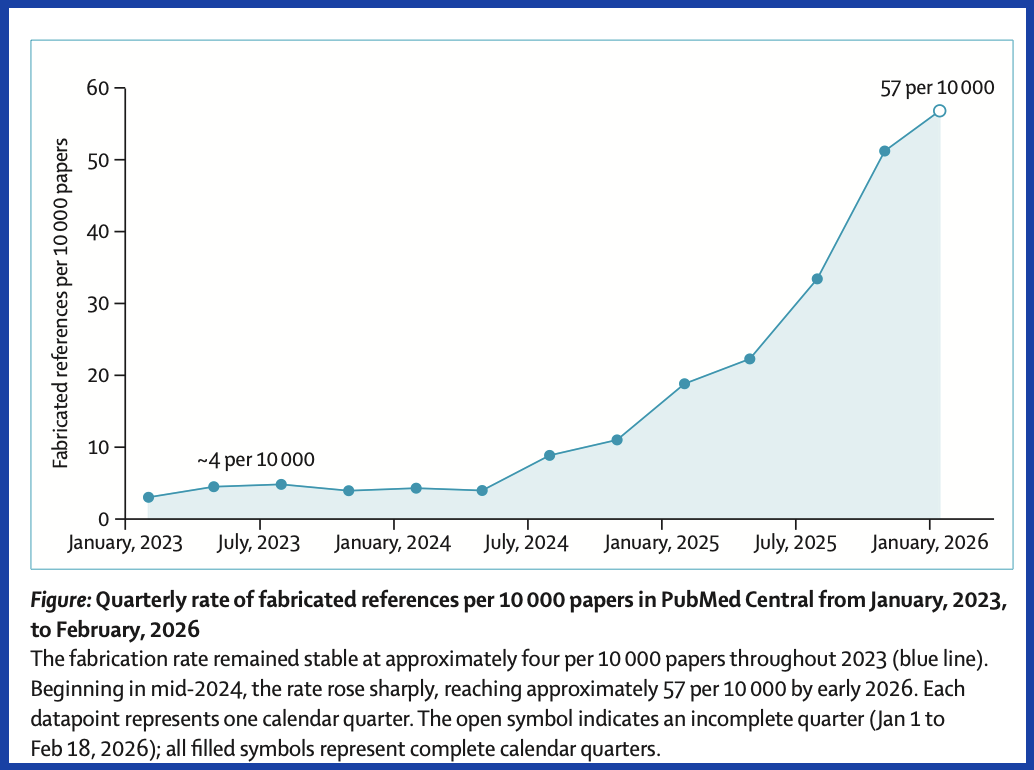
Parts of the update are easy to endorse. Authors are now told not to use AI to generate or format references at all, and to check every reference themselves, after JAMA Network journals kept receiving manuscripts that cited papers that do not exist. We measured the scale: by early 2026, one in every 277 papers in PubMed Central carried at least one fabricated reference.
The peer review rule is where I hesitate. AI in peer review remains banned outright, largely on confidentiality grounds, and that concern is real. But a Frontiers survey of 1,600 researchers across 111 countries found that 53 percent of peer reviewers have already used AI in their reviewing.
Reviewers are volunteers. In March I counted the review requests in my own inbox: 882 in a single year, from 123 journals. Total payment offered: $0. This guidance asks those same volunteers to do the work slower, by hand, in the name of confidentiality, while the journals asking have built them nothing in return: no sanctioned review assistant, no verification layer to take the clerical checks off their desks.
A confidential review tool that runs inside a journal's own system is buildable today. So is reference verification at submission. The guidance is precise about what reviewers may not do. It is silent about what journals will build for them.
What has your journal built for its reviewers?
View on LinkedIn ↗ ▶ LinkedIn · July 2026 680 likes · 56 comments
My paper about fake science went viral. That is the part that worries me.
In May my team published a research letter in The Lancet. We scanned 2.5 million biomedical papers and found fabricated references rising more than twelvefold since 2023. The paper sat among The Lancet's most-read articles for weeks. More than a hundred news stories picked it up. My three LinkedIn posts about this work have been seen almost 750,000 times.
By every measure of attention, the best month of my scientific life.
But why? The paper deserved it. It said something many of us were seeing and not saying out loud, at the exact moment the field was ready to hear it. But it also had every property the feed rewards. One number that stops a scroll: one in 277 papers cites a study that was never written. A villain. An anxiety about AI that everyone already carries. Its importance arrived in a shareable shape.
I have also published work I believe matters as much or more. Careful, thorough studies, years of effort, findings clinicians could use tomorrow. Almost nobody outside my field ever saw them. The work was just as strong. Its importance simply has no villain and no number. It comes in a shape the feed cannot see.
Last month Nature argued that scientists of the future will not read articles the way we do now. I think the shift already happened one level up. The feed now decides which science gets seen at all.
And the same machine moves fabricated science fastest of all, because fabrication is engineered for exactly that shape.
Think of your most important paper, the one almost nobody read. What was it missing, besides a hook?
View on LinkedIn ↗ ▶ LinkedIn · June 2026 2,286 likes · 149 comments
Here is something most academics will never say out loud. Almost no one reads our papers.
You spend years on a study. It survives peer review, it gets published, and then it goes quiet. A few citations. A handful of specialists. Maybe a polite email. You learn to make peace with the silence, because that silence is the norm.
Yesterday I flew out of Seattle in a middle seat between two strangers. The woman beside me saw me typing and asked if I was an academic. We started talking about AI. Then she brought up something she had been following on her own: fabricated references in scientific papers, and how fast the problem was growing.
She pulled up the Lancet paper on her phone. She had read it. She had real questions about it. She had already sent it to a group of friends.
I told her I wrote it (my Taylor Swift moment!)
She was an academic too, in public health. So this was not someone reacting to a headline. It was a researcher in a different field who had found the paper herself, read it closely, and passed it along. We ended up taking a photo before the plane landed.
That almost never happens to a piece of research. This one crossed the walls between fields because the topic has left the academy entirely. Whether you can trust what you read, whether the citations are even real, is no longer a niche worry. It is something people carry around now.
We may be underestimating how much people care whether science is still real.
View on LinkedIn ↗ ▶ LinkedIn · May 2026 1,543 likes · 324 comments
An AI-generated citation almost made it into one of my publications. The journal's editorial team caught it before publication.
I study AI hallucinations for a living. I used AI to edit my writing, and it added a fabricated reference. The reference looked completely real. I missed it.
If my paper got that far, I thought, what is happening everywhere else?
I built a pipeline to scan PubMed Central for references that point to nothing. I expected a few hundred fakes in a corpus of 2.5 million papers.
I found 4,046. Across 2,810 papers. 91% of those papers contained only one or two fabricated references, almost certainly the same kind of mistake I almost made.
In their commentary on our paper, two former editors-in-chief of JAMA classify these fabrications as research misconduct and call for the retraction of every affected paper.
That would mean thousands of retractions. The egregious cases clearly warrant it. The surgical paper we found with 18 fabricated references out of 30 is fraud, not error. But the cases where a careful researcher missed one hallucinated reference? I keep thinking about how easily that could have been me.
A blanket policy treats good-faith error and paper mill output as the same. They are not the same. But "honest AI mistake" risks becoming the loophole every paper mill exploits.
I do not have a clean answer. This needs to be debated in the open before publishers default to whatever is easiest.
Retract them all, or is there a defensible middle path?
View on LinkedIn ↗ ▶ LinkedIn · May 2026 3,840 likes · 291 comments
I expected the Lancet paper to land. I did not expect what came after.
In four days, more than 50 outlets have covered our Lancet paper on fabricated citations. Nature. STAT. Retraction Watch. CIDRAP. CBS interviewed me. Eric Topol, MD shared it. The conversation reached Reddit, Bluesky, and group chats of journal editors I will never see.
Every interviewer asked some version of the same question: what is the scariest part of this?
The scariest part is not the 4,046 fabricated references we found. It is where some of them end up.
Fabricated references have already been cited in systematic reviews. Systematic reviews feed clinical practice guidelines. Clinical practice guidelines tell physicians how to treat patients. When a guideline rests on an evidence chain that includes a study that does not exist, every patient treated under that guideline is being treated based partly on fiction.
This is not theoretical. A 2025 paper published in JAMA Network Open documented the inclusion of paper-mill articles in systematic reviews of the life sciences. Our findings show that fabrication rates have been accelerating since then.
The window to fix this is narrowing. Every month, publishers do not adopt verification at submission, more fabricated references enter the permanent record. Some of them will end up in the next round of guideline updates. Some of those guidelines will inform care decisions made next year on people you know.
The technology to verify references at submission exists today. The will to deploy it is what is missing.
If you sit on a guideline committee, in a journal editorial role, or at a publisher: the window is closing.
View on LinkedIn ↗ ▶ LinkedIn · May 2026 2,341 likes · 237 comments
We scanned 2.5 million biomedical papers.
In PubMed Central from January 2023 through February 2026, we identified 4,046 references that point to studies that do not exist. Real-sounding titles. Real journal names. Identifiers that lead nowhere. The papers are not real.
The rate has grown more than 12-fold since 2023. In early 2026, one in every 277 papers in PubMed Central contains at least one fabricated reference. A 2025 surgical paper cited 18 fabricated references out of 30. All attributed to real urologists. All with publication years of 2023 or 2024. None exist.
98.4% of the affected papers have received no correction, no retraction, no publisher action of any kind.
I started building this verification system after an AI-generated citation nearly made it into one of my own papers.
The findings publish tonight in The Lancet, and the editors selected a quote from the paper for the cover of the issue. It is the largest systematic audit of reference integrity in biomedical literature. In a commissioned commentary running alongside, two former editors-in-chief of JAMA classify fabricated references as research misconduct and call for the retraction of every affected paper.
This is not a quirk of how AI writes. It is a structural failure of how peer review verifies. No reviewer reads every cited paper. No journal checks every DOI. The system was built on the assumption that authors do not invent sources. That assumption no longer holds.
The technology to verify every reference at submission already exists. The barrier is not technical. It is institutional.
Is your journal verifying references at submission, or still trusting the honor system?
View on LinkedIn ↗ ▶ LinkedIn · March 2026 6,165 likes · 369 comments
I'm a professor at Columbia University. I study AI in healthcare. I am also frequently asked to review academic papers that authors submitted to journals.
Last week I scanned my inbox. Both Gmail and Outlook. Every email, 12 months.
882 peer review requests. From 123 different journals. That is 2.4 requests per day, every single day. Weekends. Holidays.
If I said yes to all of them: up to 4,400 hours of my time. That is more than two full-time jobs. Requested for free. From one researcher. In one year.
Total payment offered across all 882 requests, from 123 journals, many owned by billion-dollar publishers:
$0.
Not a token. Not a discount. Not a coffee. Zero.
Now here is the part that should make you pause.
Many of the papers I'm being asked to review for free will charge their authors $2,000 to $12,290 to publish. The same journal. The same paper. Free labor in. Thousands of dollars out.
In 2023, six major publishers collected $2.5 billion in author fees alone. Elsevier pulled in $582 million. From authors paying to publish work that researchers like me reviewed for free.
This is not a peer review crisis. It is the most successful unpaid labor extraction system in the history of science, now being automated on both ends: AI-generated submissions reviewed by AI-generated reviewers, with billion-dollar publishers collecting fees in the middle.
How is your journal still defending this model?
View on LinkedIn ↗ 



Research and scientific integrity
Fabricated citations, AI hallucinations in the scholarly literature, publication ethics, and the CITADEL audit published in The Lancet.
AI in healthcare
Large language models, AI scribes, clinical decision support, and the future of AI-assisted care.
AI safety and ethics
Bias in healthcare AI, patient privacy, algorithmic fairness, and responsible AI development.
Nursing and technology
How AI is transforming nursing practice, documentation burden, and nurse-patient relationships.
Home healthcare innovation
Predictive models for patient risk, remote monitoring, and improving care for aging populations.